Solar string lights: how they work, run time and tips for use
Guide
Thinking of putting up solar string lights in your garden, on your patio, under a pergola or on a balcony?
Before buying, you may already have asked yourself these questions:
“Do solar fairy lights really work without sun?”
“Why won’t my solar light come on?”
“Should I switch it off during the day or at night?”
“Does it work in winter?”
“Can solar string lights catch fire?”
“How much sun does the panel need for a good run time?”
These are perfectly normal questions. A solar light is practical, economical and easy to install, but you shouldn’t ask the impossible of it either: to work well it needs light, and ideally several hours of real, direct sunshine.
In this article, we answer the most common questions about solar string lights simply, with no marketing hype.
Solar string lights in short
- Solar string lights charge their battery through the solar panel during the day and switch on by themselves at dusk.
- Without direct sun they still charge, but more slowly. Under grey skies and in winter they stay lit for less time; in permanent shade or behind a window, the charge is usually not enough.
- ON or OFF? The panel charges the battery in both positions. On ON, the lights come on by themselves every evening; on OFF, they stay off and keep their whole charge, which is useful for the first charge, after grey days or before storing them.
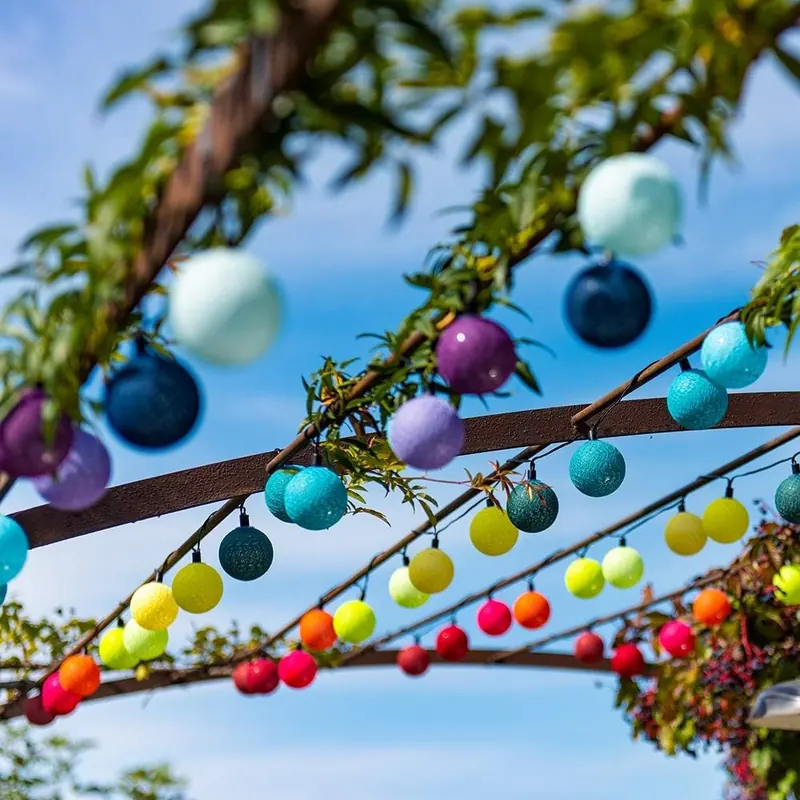
- Run time at Guirled after a sunny day: up to 8 hours for solar cotton ball fairy lights, up to 16 hours for the 16 LED Guinguette at half brightness.
- Not lighting up? Check the switch, the connector, the position and the cleanliness of the panel, then charge for a full day in the sun. To set them up step by step, see how to install an outdoor solar light.
How do solar string lights work?
Solar string lights rely on three main parts:
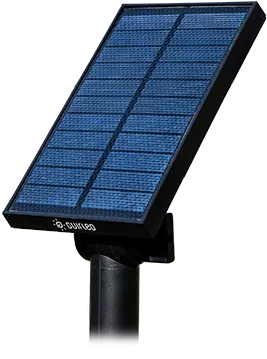
☀️ a solar panel
🔋 a rechargeable battery
💡 low-energy LEDs
During the day, the solar panel captures sunlight and turns it into electricity. That energy is then stored in the battery.
In the evening, as the light fades, a dusk sensor detects the darkness and switches the LEDs on automatically.
In other words, the lights don’t run directly “on the sun” while they are shining. They run on the energy stored in the battery during the day.
That is why two identical sets can give very different results: lights with a panel facing south all day will usually last far longer than a set placed under a tree, behind a hedge or on a very shady balcony.
Do solar string lights work without sun?
This is probably the most important question.
The honest answer is: yes, but within limits.
Solar string lights can charge in natural daylight, even when the sky is overcast. So they can work in cloudy weather, in winter or on a grey day.
But “daylight” is not the same thing as “effective sunshine”.
Under cloud, the panel receives far less energy than in full sun. The battery therefore charges more slowly and less fully. The result: the lights may come on in the evening, but they often won’t last as long.
In short:
- full sun for several hours: optimal charge;
- hazy sky: decent but reduced charge;
- very grey or rainy weather: weak charge;
- permanent shade: insufficient charge;
- indoors behind a window: generally not recommended.
A solar light isn’t magic. It needs proper exposure to light to perform well.
Where is the best place for solar string lights?
To get the longest possible run time, the solar panel should go in the brightest part of your outdoor space.
The ideal is a south-facing spot, with the panel tilted towards the sun and free of shade for most of the day.
As far as possible, avoid:
- trees that cast shade;
- walls or fences that block the afternoon sun;
- windowsills that are too sheltered;
- north-facing balconies;
- installing it under a solid-roofed pergola;
- panels laid flat in a dim spot.
Even a little shade can cut performance sharply. If a branch, a leaf or a post covers part of the panel, for example, charging can be much less effective.
With solar string lights, where the panel sits often matters more than where the lights themselves hang. The lights can decorate a shady patio, but the panel must be in the sun if you want a good run time.
How long do solar string lights stay on?
Run time depends on several things:
- the size of the solar panel;
- the battery capacity;
- the power of the LEDs;
- the mode you use;
- the season;
- how much sun the panel gets;
- the day’s weather.
In summer, after a fine sunny day, good-quality solar string lights can easily shine for several hours. Depending on the model, they can keep you company for much of the evening.
In winter the days are shorter, the sun is lower, the weather is often poorer and the battery has less time to charge. Run time can therefore be noticeably shorter.
That’s normal. It doesn’t necessarily mean there is a fault.
If your lights last a long time in summer but far less in December or January, the cause is usually just the lack of available light.
Why won’t my solar string lights come on?
Before assuming a fault, a few simple checks will sort out most situations.
First, check that the lights are switched ON. On some models, the button position isn’t always easy to see. Sometimes you need to press once to activate the system, then leave the panel to charge.
Next, put the panel in the dark or cover it with your hand. Many solar string lights won’t come on in daylight, even when charged, because the sensor can still detect light.
Check the connection between the panel and the lights too. A connector that isn’t pushed in properly, or that is slightly loose or damp, can stop them lighting up.
Finally, let the panel charge for a full day in direct sun. If the battery was very low, a few minutes of light won’t be enough.
So the most common causes are:
- button set to OFF or the wrong mode selected;
- panel still exposed to light;
- flat battery;
- poor connection;
- badly positioned panel;
- ageing battery;
- dirty or dusty panel.
.
Why does my solar light stay on in broad daylight?
In normal use, solar string lights should not stay on in broad daylight.
If they stay lit when it’s bright outside, there are several possible causes.
The first is very simple: the panel may be in a spot that is too dark. As far as the system is concerned, if there is too little light, it’s “night”. This often happens under a shelter, in a very shady corner of the patio or behind dense planting.
Another possibility: the dusk sensor is blocked by dust, leaves, moss or a build-up of dirt on the panel.
It could also be an electronic fault, especially if it started suddenly when nothing about the set-up had changed.
To test it, put the panel in direct, full sun. If the lights go off, the sensor is probably working properly. If they stay on despite the bright light, there may be a problem that needs checking.
How do you charge solar string lights efficiently?
To charge solar string lights well, the main thing is to get the panel’s position right.
Here are the good habits:
- point the panel south if you can;
- tilt it towards the sun;
- keep it out of shady areas;
- keep leaves, branches and objects away from the front of the panel;
- clean the surface regularly;
- leave the panel out all day;
- don’t put it behind a window.
A dirty panel loses efficiency. Dust, pollen, dead leaves, water marks and outdoor grime all reduce the light it receives.
Simply wiping it with a soft, slightly damp cloth can already improve charging.
Can you charge solar string lights without direct sun?
Yes, but more slowly.
A solar panel can capture some natural light even without direct sun. However, charging will be less effective. It’s a bit like filling a bottle from a half-open tap: it works, but it takes longer and the bottle isn’t always full by the end of the day.
After several grey days in a row, the battery may never charge fully. The lights may then stay on for less time, or not come on at all if the charge is too low.
Some solar lights also offer back-up USB or mains charging. That is very handy in winter, during a long rainy spell or before an evening when you want to be sure of a good run time.
Should you switch solar string lights off?
In most cases, no.
Modern solar string lights are designed to work automatically. They charge during the day, come on in the evening and go off when the battery is empty or when daylight returns.
So it is generally best to leave them switched ON throughout the season you use them.
You can, however, switch them off in certain cases:
- if you are going away for several weeks;
- if you are putting the product away for the winter;
- if you want to protect the battery during a long period without use;
- if you want to stop them coming on automatically for a few days.
One word of caution: if the product is left switched off and stored for many months with a flat battery, the battery can be damaged. Before long-term storage, the ideal is to charge the battery properly, then keep the light somewhere dry.
Do solar string lights work in winter?
Yes, but often with a shorter run time.
In winter the days are shorter, the sun is lower and the weather is less favourable. The panel therefore receives less energy than in summer.
Don’t expect the same performance in December as in July.
To get better results in winter:
- put the panel in the brightest spot you can;
- avoid shade at all costs;
- clean the panel more often;
- tilt it correctly;
- use a less powerful lighting mode if there is one;
- charge by USB or mains if your model allows it.
A solar light can work perfectly well in winter, but its run time will depend heavily on the weather and on where the panel sits.
What are the most common problems with solar lights?
Faults are often simpler than you might think.
1. An ageing battery
Like all rechargeable batteries, the one in a solar light gradually loses capacity. After several years it may store less energy and give a shorter run time.
On good models the battery can be replaced, which saves throwing the whole product away.
2. A badly positioned panel
Even an excellent solar light will struggle if it is installed in permanent shade.
This is the most common cause of run-time problems.
3. A dirty panel
Dust, pollen, dead leaves, water marks or moss can reduce charging.
Regular cleaning keeps performance up.
4. A poor connection
On outdoor string lights, the connectors must be pushed fully home and, where they are waterproof, screwed up properly.
An incomplete connection can stop the lights coming on or make them cut out.
5. A deeply discharged battery
If a product has sat in its box or in storage for a long time without charging, the battery may be very low, or even deeply discharged.
In that case, try a long, full charge. If it doesn’t recover, the battery may need replacing.
6. Damp or wear
An outdoor product has to cope with rain, wind, sun, cold, heat and sometimes frost. Even when designed for outdoor use, a light can wear over time, especially if the seals, cables or connectors are damaged.
What is the main drawback of a solar light?
The main drawback is simple: it depends on the light available.
That is also its advantage. A solar light needs no socket, uses no mains electricity and can be installed easily almost anywhere. In return, though, it depends on where it is placed.
If your patio is very shady, if your balcony faces north or if the panel sits under a shelter, performance will inevitably be limited.
It’s best to be honest: solar string lights are ideal in a garden, on an open pergola, a sunny patio, a bright balcony or around a pool. They will be less suitable if the panel never sees the sun.
So, should you choose solar string lights?
Yes, if you have reasonable exposure to light and want a simple, decorative solution with no wiring.
Solar string lights are ideal for creating a warm atmosphere without running a cable, without an outdoor socket and without using mains power.
They are particularly well suited to:
- gardens;
- patios and terraces;
- pergolas;
- sunny balconies;
- outdoor dining areas;
- holiday homes;
- places where you don’t want to carry out electrical work.
But keep one simple rule in mind: the more sun the panel gets, the longer the lights will last.
That is the most honest promise we can make.
Good solar string lights won’t always replace powerful mains lighting. What they will do, very easily, is turn an outdoor space into somewhere warm, welcoming and pleasant to spend time.
And that is often exactly what you want from them.
Guirled solar string lights in 2026
Length, run time and power supply depend on the model.
| Model | Length | Run time | Mains too? |
|---|---|---|---|
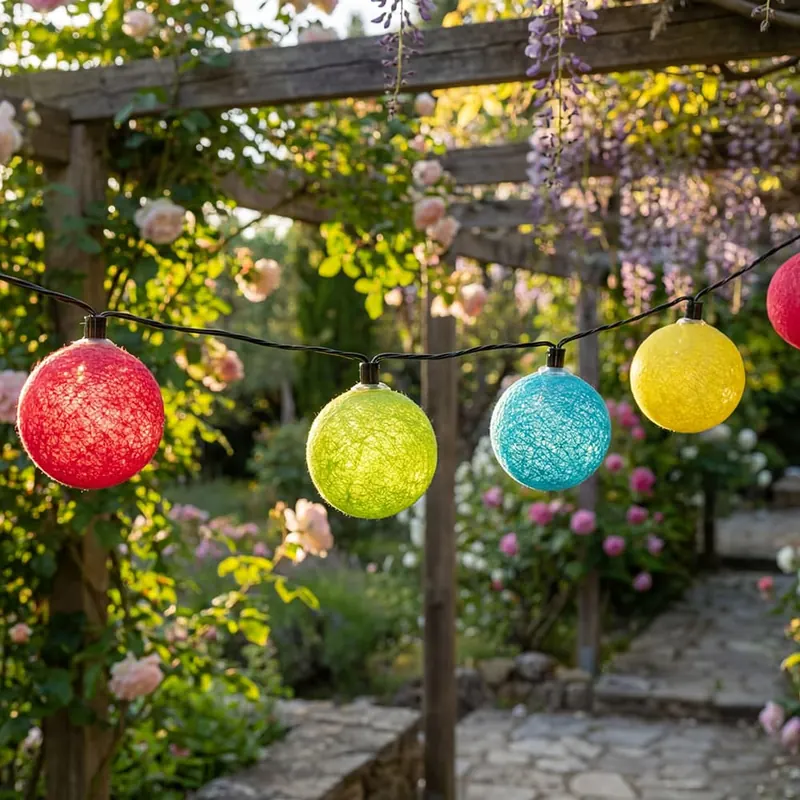
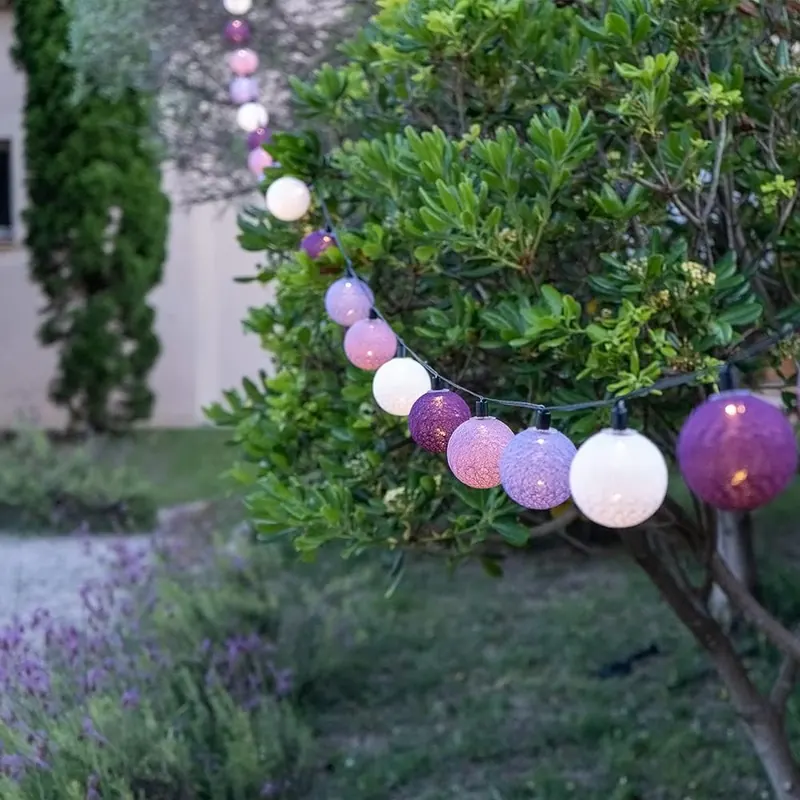
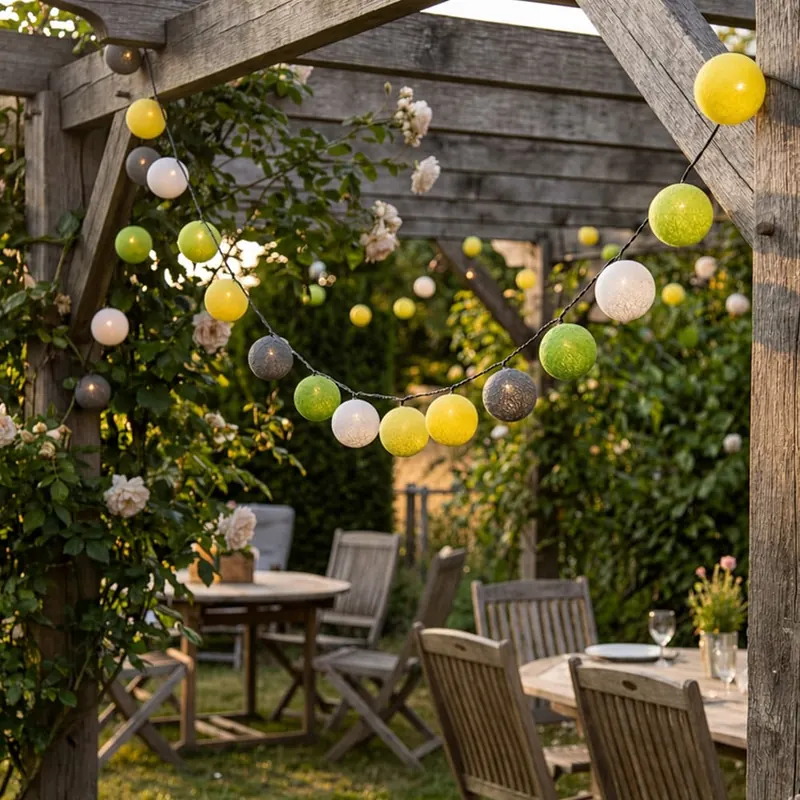
| Solar cotton ball fairy lights | 6 m with 16 balls or 9 m with 32 balls, including 3 m of lead cable | up to 8 hours, two brightness levels | no, solar only |
| Solar Guinguette festoon lights | 7.5 m with 16 LEDs, 15 m with 32 LEDs | 16 LEDs: up to 8 hours at 100%, 16 hours at 50%. 32 LEDs: 4 and 8 hours | yes, with the power adapter sold separately |
| Mini LED solar and mains string lights | 20 m with 200 LEDs | three brightness levels | yes, adapter included |
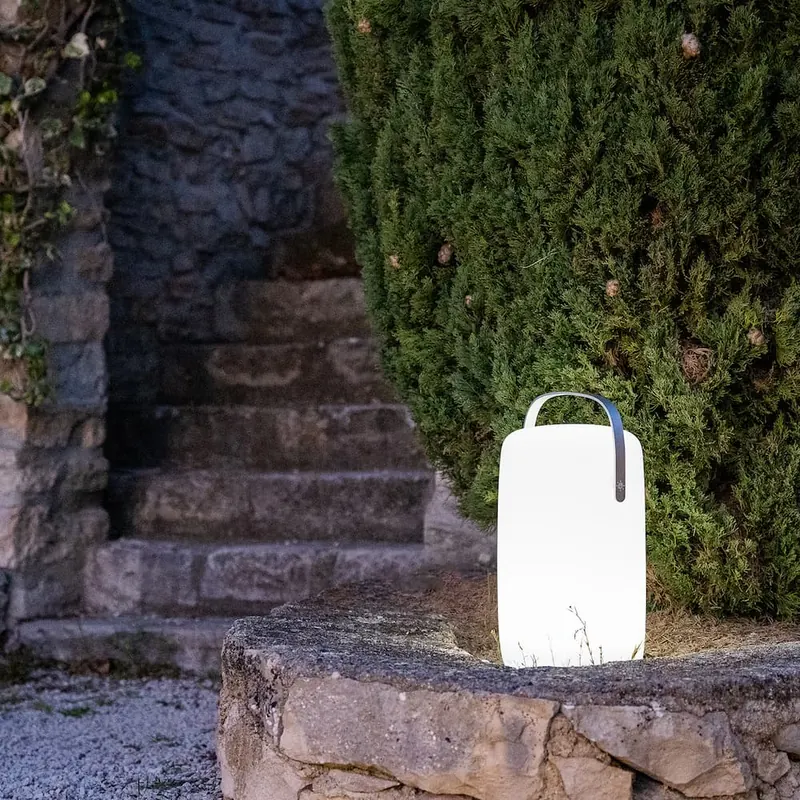
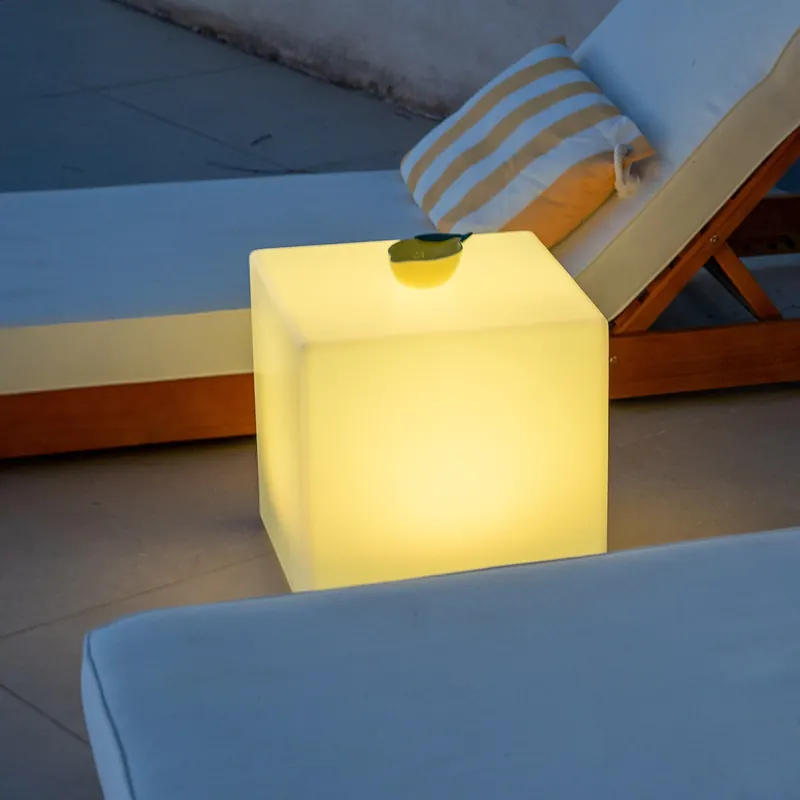
| Portable solar lamp | 40 cm high | solar: 12 hours dimmed, 6 hours at 100%; up to 40 hours after a USB-C charge | yes, by USB-C |
All three are waterproof, have a separate solar panel that you place in the sun, and carry a 3-year warranty. Run times are the maximum in summer, with the solar panel in full sun. Expect less in winter.
Article updated in November 2026.
Should solar string lights charge on ON or OFF?
Both positions charge. The panel charges the battery whether the lights are ON or OFF. The difference is at night.
| Position | By day | At night | When to choose it |
|---|---|---|---|
| ON | The panel charges the battery. | The lights come on by themselves, then go off at daybreak. | Every day, during the season. |
| OFF | The panel charges the battery. | The lights stay off: the whole charge is kept. | First charge, a run of grey days, the day before a party, storage. |
Step-by-step installation: how to install an outdoor solar light.
Solar string lights: more questions
Should you charge solar string lights on ON or OFF?
The panel charges the battery in both positions. For the first charge, leave the panel in full sun for a whole day, then press ON. After that the switch stays on ON: the battery charges during the day, the dusk sensor turns the lights on at nightfall and off again in the morning. Choose OFF to keep the whole charge: after several grey days, or the day before a party.
Do you need to switch solar lights off in winter?
No. As long as the panel gets daylight, the lights can stay on: they charge by day and light up in the evening, only for less time than in summer. Switch them off if you store them for the winter: charge them for a full day first, set the switch to OFF so that the battery does not drain, and keep them somewhere dry.
What do S, OFF and F mean on the switch of solar string lights?
On many solar string lights sold in shops, S stands for "steady" (constant light), F for "flash" (flashing light) and OFF for switched off. Guirled solar cotton ball fairy lights have a switch with two brightness levels instead. The settings for your model are in the user manual.
Do solar string lights work in the shade or behind glass?
Only poorly. In the shade and behind a window pane, far less light reaches the solar panel: the battery does not fill up and the lights stay on briefly, or not at all. The lights themselves can hang in the shade, but the panel belongs outside in the sun. That is why Guirled panels are separate and connected by a cable.
How long do solar string lights stay lit after a sunny day?
It depends on the model and on the brightness level. At Guirled: up to 8 hours for solar cotton ball fairy lights, and up to 8 hours at full brightness or 16 hours at half brightness for the 16 LED Guinguette. In winter the run time is shorter.
Can solar string lights get hot or catch fire?
LED string lights work at low voltage and use very little power. Guirled string lights use 4 watts at most and do not get hot, even after hours of use. When you buy, look for the CE mark and, for outdoor use, a protection rating such as IP55. More in 10 pitfalls to avoid when buying string lights.
Read on
Fairy lights without a plug socket Hang fairy lights without drilling Solar lighting: the complete garden guide 5 myths about solar lighting How to install an outdoor solar light All solar fairy lights Outdoor fairy lights
By Bouton on off 2026-10-04 12:56:42
Ou se trouve t-il sur les guirlande car je n’en vois pas
View replies (1) -
By Rémi (Administrateur) 2026-10-20 13:20:55
Directement à l'arrière du panneau solaire
By Odenhardt 2026-09-03 09:30:07
Bonjour, quels sont les differents "modes" des guirlandes solaires? Merci d'avance
View replies (1) -
By Rémi (Administrateur) 2026-10-20 13:21:17
100% 50% d'intensité et OFF